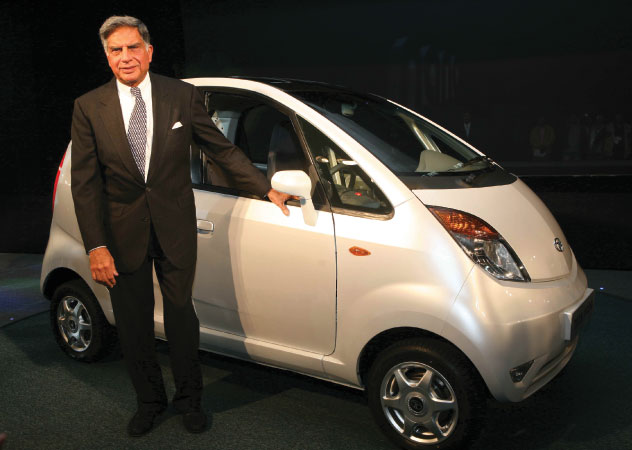
Ladies and Gentleman, thank you for being with us on this memorable occasion. There are no celebrities at this function nor any dance routines. The center of attraction for this morning's event is the new Tata car which we are unveiling.
We're going to take you on a small journey. A journey that symbolizes the human spirit of change, the will to question the unquestionable, the drive to stretch the envelope.
Ladies and gentleman, I invite you to join me in this journey of innovation and evolution. The quest to lead and the quest to conquer. It is this quest that led to the first manned flight by the Wright brothers. Today, thousands of aircrafts travel the skies carrying millions of passengers across the globe in safety and comfort. The same quest for leadership and conquering new frontiers led to landing man on the moon, an unheard of and unbelievable achievement at that time.
Innovation and evolution led to the creation of a bicycle which the rider pedaled to move faster than walking. Later, innovation motorized the bicycle to create the motorcycle and the scooter, providing motorized transport for up to two persons. The ENIAC computer in 1945, considered among the highest powered at that time filled an entire room. Today, the power of that huge machine is exceeded in the personal computer that sits on our desks or in fact, that we carry as laptops in our briefcases.
There are solutions for most problems. The barriers and roadblocks that we face are usually of our own making and these can only be demolished by having the determination to find a solution, even contrary to the conventional wisdom that prevails around us, by breaking tradition.
Today's story started some years ago when I observed families riding on two wheelers, the father driving a scooter, his young kid standing in front of him, his wife sitting behind him holding a baby and I asked myself whether one could conceive of a safe, affordable, all weather form of transport for such a family. A vehicle that could be affordable and low cost enough to be within everyone's reach, a people's car, built to meet all safety standards, designed to meet or exceed emission norms and be low in pollution and high in fuel efficiency. This then was the dream we set ourselves to achieve. Many said this dream could not be achieved. Some scuffed at what we would produce, perhaps a vehicle comprising two scooters attached together or perhaps an unsafe rudimentary vehicle, a poor excuse for a car. Let me assure you and also assure our critics that the car we have designed and we will be presenting to you today will indeed meet all the current safety requirements of a modern day car.
Of late, when it became known that we will in fact be making such a car, the attention has moved to questioning the pollution it would create. Let me again assure those who have concern for the environment that the car we present to you today will meet all current legislated emission criteria and will have a lower pollution level than even a two wheeler being manufactured in India today.
Concerns are also now being expressed about the congestion that could be caused by the existence of our small car in large numbers. I believe this needs to be put in the right perspective. There is no doubt that India is woefully behind its neighbours in infrastructure. The government is endeavoring to address this situation with its new road policy. Looking ahead, five years from today, were we to produce and sell 5,00,000 small cars every year, we would then, at the end of five years constitute approximately 2.5% of all passenger vehicles in the country. This could hardly be considered the nightmare of congestion that is being raised today about our new small car.
Despite what the critics said, despite what our antagonistic did, we pursued our vision to give India an affordable people's car that had not been produced anywhere in the world. In fact, a car that most people said could not be manufactured for that kind of price. But we never took our eyes of our goal. Today we will present what a young group of engineers and designers gave their all, for about four years to achieve.
Anyway I have said enough ladies and gentlemen, now I give you the new car from Tata Motors, the people's car that everyone has been waiting for.
Ladies and gentlemen, thank you again for being with us. We are very pleased to present these cars to you today. They are not concept cars. They are not prototypes. They are the production cars that will roll out of the Singur plant later this year. And these will come in several variants. You have today on the stage one basic car or standard car and two deluxe cars which will have air conditioning also. Yes there will be air conditioning.
This is been referred to as one man's dream and indeed it was. But it took a tremendous amount of team work to convert this or translate this into reality. And I think it would be but fair and fitting to recognize and acknowledge the achievement of young group engineers who undertook the challenge for four years and great sacrifice to themselves and produced this car. I'd like to acknowledge Girish Wagh who headed the team. Girish, would you come up here? And some of his team members who are here with him. There are close to five hundred people in the team and obviously not all of them can be here, so on behalf of all of us we would like to acknowledge, on behalf of the company what the team has been able to do. All five hundred of them. I would also like to ask Ravi Kant (Managing Director, Tata Motors Ltd.), Prakash Telang (Executive Director (Commercial Vehicles), Tata Motors Ltd.) and Rajiv Dube (President (Passenger Cars), Tata Motors Ltd.) to join me up here at this time.
Let me say something about the car. The cars you see, as you can, are four door, they will seat four to five persons, they are powered by a 33 horse power, 624 cc engine. In size, externally it is approximately 8% smaller, bumper to bumper, than the Maruti 800. But internally it is 21% larger in passenger space. Fuel economy in terms of mileage, it'll be around 20 kilometers per liter or approximately 50 miles a gallon.
As I said earlier, much has been said about emission and much has been said about congestion and safety. Let me address the emission and the safety issues. In emissions as I mention, the car has, in fact passed the full frontal crash test that is required in this country (India). But it is also been designed to pass the offset and the side crash which is required internationally. So that the car can, in fact, be sold internationally.
In terms of pollution, it today confirms to Bharat III and in fact today with this engine will indeed meet Euro IV which is not yet required in this country (India).
We decided we'd call it Nano because it connotes high technology and small size. So we stayed with the name.
Finally all of you have been conjecturing about the price. And since we commenced this exercise four years ago, we are all aware that there has been a very steep increase in input prices of steel, tires and various and sundry other inputs. Bearing all this in mind, I would like to announce today that the standard car will in fact have a dealer price of One Lakh Only (100,000 INR), VAT and transport being extra. Now having said that, I just want to say that that is because a promise is a promise and that's what we would like to leave you with.